
Resources



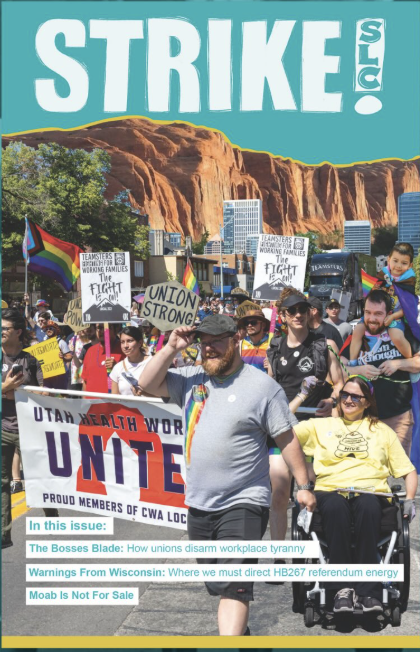
Strike! Magazine
Local Labor Publication
STRIKE! Magazine is a freely distributed publication which covers local working class struggles which fly beneath the radar of any mainstream news outlet, written and produced by members of OUT. There are workers fighting back all around SLC, but it's hard to find and learn from these organizers. In each issue you’ll find stories of people fighting for big and small wins, for dignity and in solidarity with their coworkers and community.
You can find STRIKE! at the Utah Workers Center, Ken Sanders Rare Books, and Publik Coffee (Ballpark location).
Reading Essentials
Organizing your workplace can be ruthless work with a steep learning curve. Other than attending the Organizer Crash Course and connecting with an experienced organizer, you can check out these books and materials which might give you a leg up:
Organizing Methods
Unite & Win: The Workplace Organizer's Handbook
by EWOC
No Shortcuts
by Jane McAlevey
Class Struggle Unionism by Joe Burns
Organizing Methods in the Steel Industry
by William Z Foster
Labor History

Podcast: Fragile Juggernaut
by Haymarket Books
Teamster Rebellion
by Farrell Dobbs
Union Directory
Get to know Utah’s local labor landscape! Find your industry or your union and follow the links to learn more.
-
-
Education support professionals:
Utah School Employees Association (USEA)
United Campus Workers of Utah (CWA 7765)
Higher education faculty:
Non-faculty higher education staff:
-
University of Utah Health, front-line workers:
Utah Health Workers United (UHWU) CWA Local 7765
George E. Wahlen VA Medical Center, civilian employees:
American Federation of Government Employees (AFGE) Local 2199
-
Utah Transit Authority bus drivers, TRAX and FrontRunner operators, and mechanics:
Utah Transit Authority warehouse and production control staff:
Flight attendants:
Pilots:
Locomotive engineers and train operators:
Brotherhood of Locomotive Engineers and Trainmen (BLET/IBT) Division 221
Railroad:
Trucking, freight, and warehouse workers:
-
Electricians:
International Brotherhood of Electrical Workers (IBEW) Local 354
Plumbers / Pipefitters / HVAC-R / Welding:
Carpenters:
Western States Regional Council of CarpentersLocals 184, 1507, 801
Ironworkers (structural) Local 27
Sheet Metal Workers:
Painters & Allied Trades:
Roofers:
Bricklayers & Allied Craftworkers:
Cement Masons & Plasterers:
International Association of Bridge, Structural, Ornamental and Reinforcing (OPCMIA) Local 568Rio Tinto Kennecott's copper mine, smelter, and refinery:
Production and maintenance workers, United Steelworkers (USW) Local 392
Equipment operators, International Union of Operating Engineers (IUOE)
Machinists/mechanical trades, International Association of Machinists (IAM)
Electrical trades, International Brotherhood of Electrical Workers (IBEW)
-
Rocky Mountain Power / PacifiCorp:
International Brotherhood of Electrical Workers (IBEW Local 57)
-
Communications Workers of America (CWA)
Salt Lake Tribune:
-
SunTrapp Workers Unite (CWA 7765)
Starbucks Workers United UT (SBWU)
Retail/grocery (Smith’s/Kroger):
United Food and Commercial workers Union (UFCW Local 711)
-
Principles to Build Power
-
A union is a group of workers, usually in a workplace, company, or sector, who come together to fight their bosses for better conditions in their workplace and their community.
All sorts of workers are in labor unions; teachers, doctors, warehouse workers, bus drivers, rideshare drivers, baristas, non-profit workers, cleaning staff, grad student workers, geologists, just to name a few. When workers are organized into unions, they can fight for and win higher wages, better benefits, safer working conditions, anything that a worker’s labor touches, an organized union and community effort can change for the better. The workers actually do the work to produce wealth, so they have the power.
-
The rank-and-file of a union are its members, the workers that make up a labor union, or the tenants that make up a tenant union.
As unions grow (and growth is good!) the need for union staff arises: people who are not employed by the boss, but by the union itself from dues money. Union staff are important in coordinating the action of members, but a strong and democratic union must led by the rank-and-file.
-
Unions that have a class struggle outlook understand that all workers, in all workplaces, have more in common with each other than they do with their bosses, and that to make societal change, workers need to work together as a class.
They understand that unions need to be highly participatory and run by the rank and file. They understand that a union’s power comes form how organized it’s workers are. They know that workers and their bosses have opposed, contradictory interests, and that bosses view every advancement of worker organization as a direct attack on their interests. When unions were fighting with outlook, great things were achieved, from The New Deal, to Social Security, to countless local and regional victories that uplifted the lives of the workers who fought for more.
-
Class struggle unionism is in opposition to business unionism. Unions that have a business outlook seek to make deals with bosses. Business unions do not have high levels of member participation and they tend to be run by staffers and with an elite cadre of elected leadership. Business union officials may say that the best way to win is by having a good relationship with the boss. This outlook has led to a deep decline in the power of organized labor and the working class.
-
Many labor unions today have fallen into business unionism. This is an orientation that is characterized by low rank-and-file participation, union decisions being made mainly by staffers and elected union officials, and the idea that a union’s power is rooted in the friendly relationships with management.
-
Tenant unions are similar to labor unions, but instead of workers and bosses, think tenants and landlords.
Tenant unions may organize in a different structure, apartment buildings instead of workplaces, but they use similar tactics. Tenant organizers have one-on-one conversations with their neighbors, plan socials, organize petitions, march on the landlord, just like a worker organizer would talk with their coworkers, or march on their boss. The tenants pay the rent, so they have the power.
-
Worker power is rooted in their own labor. Without the worker’s labor, there is no production, a workplace cannot operate. That power is expressed through their collective ability to coordinate and withhold their labor.
This is why strikes (when all the workers in a workplace, company, or sector refuse to work) are effective, once a supermajority of workers collectively withhold their labor, the workplace, company, or sector ceases to function, no money can be made by the bosses, and that gives workers the leverage they need to win their demands.
-
Organize Utah events designed to connect you to the people are resources that are right for you!
Completely new to labor organizing? Start with the Organizer Crash Course to receive a new set of skills to bring back to your workplace and share with your coworkers.
Looking to connect with other worker-organizers? Attend one of the upcoming social events.
Already organizing your workplace and need some help? Visit a monthly Organizer Support Group for advice, networking, and resources.